Home › Industrial and Heavy-Duty Asphalt Paving
Precision Asphalt Detroit specializes in industrial asphalt paving in Detroit, MI for facilities that handle heavy trucks and equipment. We design thick asphalt sections and strong bases for truck courts, loading docks, and warehouse aprons. Our heavy duty asphalt paving resists rutting and premature failure. Contact us to engineer a pavement structure that supports your industrial traffic.
Precision Asphalt Detroit provides professional industrial asphalt paving throughout Detroit, MI, Michigan and the surrounding area. Our licensed, insured crew delivers safe, clean, on-time work with a free estimate before anything begins. Call (313) 889-7046 or request your free quote.
Industrial Asphalt Paving for Detroit’s Toughest Sites
Industrial asphalt paving is very different from a basic parking lot or driveway. At heavy-use sites around Detroit, the pavement has to stand up to loaded semis, forklifts, container stacks, fuel spills, and Michigan’s freeze-thaw cycles. Precision Asphalt Detroit focuses on designing and building pavement structures that match the real stresses on your site, not a one-size-fits-all section pulled from a textbook.
When we visit your property, we look at how your operation actually runs. For example, where trucks turn sharply, where trailers are parked for days, where front loaders scoop and pivot, or where tankers are filled. These areas each need different asphalt thickness, base support, and sometimes a different mix design. For many industrial yards, we design at least two or three pavement zones, such as higher-strength asphalt in loading dock lanes, reinforced aprons at entrances, and more economical sections in overflow parking.
We also factor in Detroit’s climate. Heavy-duty asphalt that might work in a warmer state can rut or crack here if the mix is not adjusted. Our industrial asphalt paving mixes consider temperature swings, frequent plowing, and deicing chemicals. We specify aggregates and binders that resist rutting in summer heat along I-75 and I-94, while still being flexible enough to survive winter without shattering into a web of cracks.
How Industrial and Heavy-Duty Asphalt Paving Is Actually Built
A durable industrial pavement starts with what you cannot see. Precision Asphalt Detroit begins with subgrade evaluation. We test and probe the existing soil and base, checking for soft spots, organics, and trapped moisture that will cause pumping and fatigue cracking later. If we find weak areas, we cut them out, undercut to a defined depth, and rebuild with compacted aggregate or, on very poor soils, use geogrid reinforcement.
Next, we construct the aggregate base. For most heavy-duty truck routes or loading docks, this means a thicker, crushed limestone or crushed concrete base, compacted in multiple lifts with proof-roll testing. You might see us driving a loaded truck over the new base to visually confirm there is no flexing or deflection. Only when the base passes this check do we move to asphalt.
For industrial asphalt paving, we rarely install a single lift. Instead, we use a layered system. A common approach is a strong base course with a stiffer binder, followed by an intermediate course in major traffic lanes, and then a surface course engineered to resist fuel and oil drips. At very heavy terminals or intermodal yards, we may design total asphalt thickness of 6 to 10 inches or more, with extra depth in wheel paths where tandem axles sit.
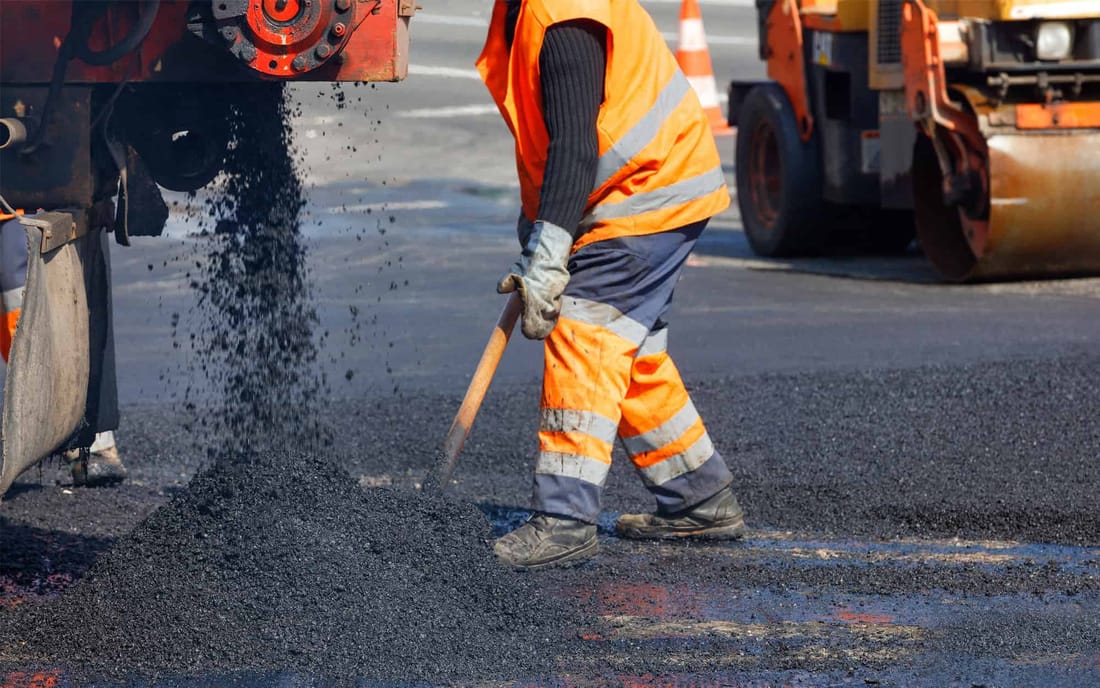
Placement quality matters as much as thickness. We use calibrated pavers, matched rollers, and a rolling pattern designed for your mix and temperature. On industrial jobs we pay close attention to longitudinal joints, because joint failure is a common starting point for potholes. Our crews stagger joints away from wheel paths and use joint heaters or tack coats so those seams become as strong as the surrounding mat.
Material Choices, Mix Designs, and Local Considerations
Not all asphalt mixes are suitable for industrial use. Precision Asphalt Detroit works with local plants to specify mixes that match traffic loading, site use, and Detroit’s specific weather patterns. For truck yards and plant access roads, we often recommend a higher-performance binder with modified asphalt content to resist rutting from slow-moving, loaded trucks. In high-turn areas such as forklift lanes or tight-radius entrances, we may specify a coarser aggregate gradation that resists shearing and shoving.
Where fuel and oil spills are likely, such as near fueling stations, maintenance bays, or loading areas for tankers, we can incorporate fuel-resistant surface courses and recommend a sealing and maintenance plan that limits softening. If your operation includes steel-tracked equipment, such as certain construction or scrap-yard machines, we may suggest a combination of asphalt and concrete pads, so the highest wear areas do not chew up your asphalt investment.
Detroit’s winters affect material timing too. On large industrial projects, we often phase work so base and binder courses are placed in warmer months, then the final surface course is laid in the most favorable window. This approach reduces the risk of cold-weather compaction problems and helps the surface course last longer by avoiding early-season deicing damage. We also schedule around your production, coordinating night or weekend paving to keep access open and avoid disrupting shipping schedules.
Costs, Lifecycle, and Common Industrial Pavement Problems
Industrial asphalt paving is an investment, and understanding what drives the cost helps you budget intelligently. The largest cost factors are total pavement thickness, aggregate base thickness, site accessibility, and the amount of handwork needed around utilities, rails, manholes, and drains. Deep pavement sections for heavy trucks require more material and time, but they can dramatically extend the life of the pavement compared with a “light commercial” section that would fail under industrial use.
Existing conditions also make a difference. If your Detroit site has old, alligator-cracked asphalt with base failures, it is often more cost-effective to mill and remove the failed layers and correct the base, rather than simply overlay. Otherwise, the new asphalt will mirror those failures quickly. On the other hand, if the base is sound and only the surface is oxidized or lightly rutted, a properly designed mill and overlay can add many years of service at a lower cost.
Common problems at industrial sites include rutting in wheel paths, reflective cracking over utility trenches, ponding water that breaks down the surface, and edge failures where trucks “fall off” the pavement edge. Precision Asphalt Detroit addresses these during design. For example, we may deepen sections in primary wheel paths, provide thicker edges or concrete ribbon edges in high-drop zones, and reshape grades so water truly drains instead of sitting in front of docks. When we overlay existing pavement, we often use reinforcing grids or special tack treatments over known crack lines to slow their return.
We also encourage customers to budget for targeted maintenance instead of waiting for major failure. Routine crack sealing, addressing early depressions, and sealing joints around drains can add years of heavy-duty service, especially through Michigan’s repeated freeze and thaw cycles.
What Detroit Industrial Customers Should Expect When Hiring Us
When you contact Precision Asphalt Detroit about industrial asphalt paving, the first step is an on-site walk-through with someone who understands both pavement engineering and plant operations. We will ask specific questions: what is the heaviest axle load on site, where trucks queue, what areas see static loads, and where snow gets pushed and piled. These details directly affect our design and proposal.
Next, you receive a written plan, not just a lump-sum number. Our proposals spell out pavement section thicknesses by area, base preparation steps, drainage changes, and any phasing that keeps critical access open. If you have rail spur crossings, scales, dock levelers, or embedded track, we will outline exactly how we will protect or adjust to those features.
During work, our foreman coordinates with your site contact each day so your operations team knows when certain lanes will close and reopen. We can phase paving so one half of a truck court remains open, or schedule high-impact work after hours. On industrial jobs in Detroit, we also stay alert to utility constraints and local permitting requirements. If your project requires city inspections or coordination with other trades, we factor that into the construction schedule.
Before we leave, we walk the site with you, explain what to watch for during the first season, and provide a maintenance guideline tailored to your site, including recommended timing for the first sealcoat if appropriate, and how to handle snowplows and deicers without damaging the new industrial pavement. The goal is not just to install heavy-duty asphalt, but to make sure it performs under your actual daily use for as long as possible.