Home › Road, Street, and Municipal Paving
Precision Asphalt Detroit performs road paving in Detroit, MI for private streets, subdivisions, industrial parks, and municipal projects. Our crews handle full roadway construction, from grading and base to asphalt placement and compaction. We focus on proper drainage, joint construction, and smooth ride quality. Reach out to discuss upcoming road and street paving needs.
Precision Asphalt Detroit provides professional road paving throughout Detroit, MI, Michigan and the surrounding area. Our licensed, insured crew delivers safe, clean, on-time work with a free estimate before anything begins. Call (313) 889-7046 or request your free quote.
Road, Street, and Municipal Paving in Detroit
Road paving in Detroit is not just putting down blacktop. It is traffic engineering, drainage planning, and long term durability, all tailored to our freeze-thaw climate and heavy vehicle loads. Precision Asphalt Detroit focuses on municipal, county, and private roadway projects inside Metro Detroit, so our crews understand the specific requirements of local agencies and the realities of our streets.
We work on neighborhood streets, commercial access roads, industrial park drives, and public municipal routes. For each, we evaluate expected traffic (passenger vehicles, buses, trash trucks, semi trucks), soil conditions, existing pavement structure, and drainage paths before recommending any pavement section. This up-front planning is what determines whether your road lasts 5 years or 25.
Our team is fully equipped for both full depth reconstruction and mill and overlay projects, and we coordinate with local utilities and inspectors in Detroit, Wayne County, and surrounding jurisdictions to keep your project compliant and on schedule.
How We Evaluate an Existing Roadway
Before any road paving starts, Precision Asphalt Detroit performs a structured assessment of the existing pavement. For municipal and private streets, we typically begin with a visual pavement condition survey, locating potholes, alligator cracking, edge failures, rutting, and standing water areas. We map these issues and categorize them by severity.
Where needed, we perform test cuts or core samples to measure the thickness and condition of the asphalt and base course. In many Detroit neighborhoods the existing base is a mix of old slag, cinders, and fill, so verifying its stability is important. If the base is pumping water or shows significant contamination, we know a simple overlay will fail quickly.
We also check drainage. Roads in Detroit commonly suffer from flat grades and clogged or undersized catch basins. We shoot grades with a laser or total station along gutters and centerlines to see where water is trapped. Correcting these low areas or adjusting structure elevations is critical, otherwise even a brand-new pavement will ravel and crack prematurely from standing water and winter freeze cycles.
Planning the Right Road Section and Materials
Once we understand the existing conditions, we design the pavement structure. For most local roads and municipal streets, this begins with specifying the asphalt mix and base thickness. Precision Asphalt Detroit commonly uses MDOT or municipal spec mixes, such as 13A or 36A surface courses over 4E3 or 4E1 base courses, tailored to traffic volume and project budget.
Light residential streets that only see cars and light delivery vehicles may use a thinner asphalt section over a well compacted crushed concrete or limestone base. Bus routes, industrial access roads, and streets with frequent trash collection often require thicker asphalt and, in some cases, a stronger aggregate base. The right design might be 3 lifts of asphalt over a deep, mechanically stabilized base if we know heavy trucks will be stopping and turning frequently.
We also consider whether to use traditional dense graded asphalt or include leveling courses to smooth older pavements, as well as tack coats that ensure bonding between new and existing layers. For municipally funded projects we coordinate our designs with city engineers so the mix design, compaction requirements, and thicknesses meet the appropriate standards before we mobilize.
Our Road Paving Process, Step by Step
Precision Asphalt Detroit follows a structured paving sequence to keep roads safe, smooth, and durable.
1. Traffic control and staging: We create a traffic control plan that satisfies Detroit or county requirements, which can include detours, flaggers, barricades, and signage. On residential streets we often phase the work so residents maintain access, alternating sides or blocks.
2. Milling or demolition: For mill and overlay projects, we profile mill the existing asphalt to a set depth, usually 1 to 3 inches, ensuring smooth transitions at driveways, intersections, and manholes. For full reconstruction, we remove existing asphalt and, when required, part of the base. Spoils are hauled off or recycled as aggregate base when allowed.
3. Subgrade and base preparation: The exposed subgrade is proof rolled with heavy equipment to identify soft or pumping areas. Weak spots are undercut and replaced with compacted aggregate. We then place and compact the aggregate base in lifts, using vibratory rollers to achieve target densities and cross slopes that promote drainage toward gutters or swales.
4. Fine grading and structures: We trim the base to final grade, adjust manholes, valve boxes, and catch basin frames to new elevations, and verify the surface with string lines or laser equipment.
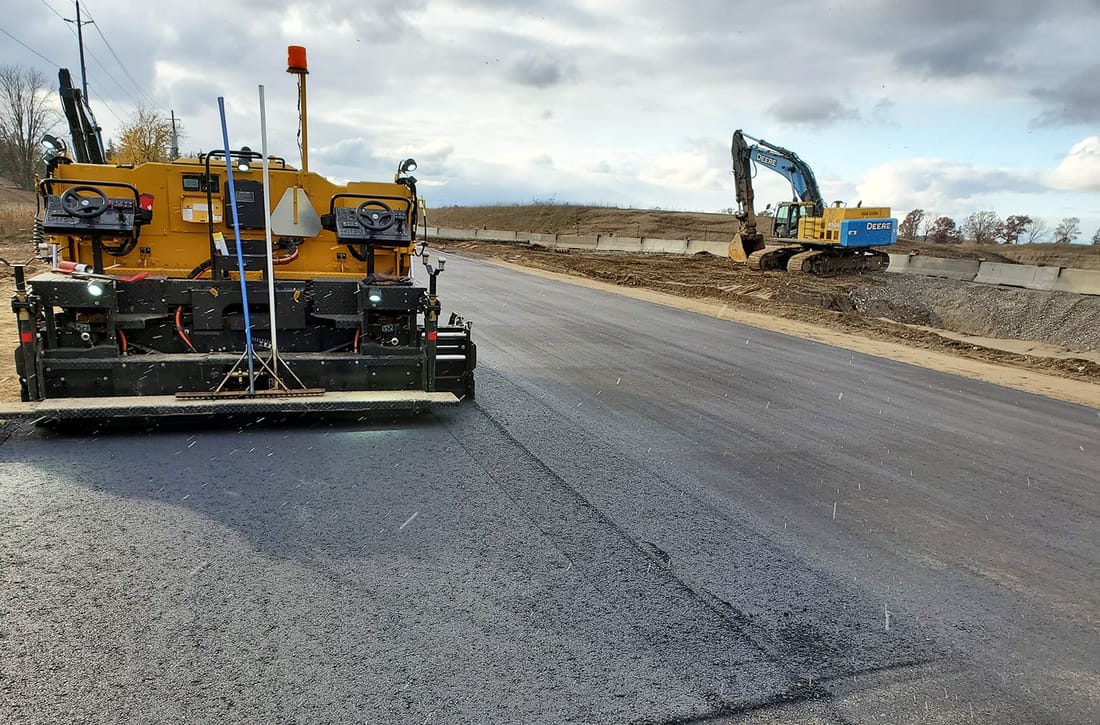
5. Asphalt placement: Tack coat is applied between old and new surfaces to ensure bonding. Asphalt is then placed in one or more lifts, depending on the design. We use pavers with automatic grade and slope controls for long, straight sections, and hand-work transitions at driveways and curb returns to eliminate abrupt changes.
6. Compaction and quality checks: Rollers compact each lift while the mix is within the specified temperature range. Our crew checks mat temperature, joint quality, and surface smoothness, and performs density tests to ensure the pavement meets spec. Joints are carefully matched and rolled to avoid weak seams.
7. Cleanup and striping: After paving, we broom and sweep the roadway, then coordinate pavement markings, crosswalks, and stop bars. For municipal roads, we follow the approved striping plan and MUTCD standards.
Dealing With Detroit Weather, Utilities, and Scheduling
Local conditions in Detroit have a direct impact on how and when road paving should be done. Asphalt paving is best scheduled from late April through October, when ground and air temperatures are stable enough for proper compaction and curing. Trying to place surface courses too early or too late in the season can lead to insufficient density and premature cracking.
Precision Asphalt Detroit plans municipal paving work around these weather windows. For longer projects, we may pave base courses first and come back for surface in a later phase to avoid trapping moisture or subjecting new surfaces to winter damage before striping and final inspection.
We also coordinate with underground utilities, which are dense in older Detroit neighborhoods. Before milling or excavating, we obtain MISS DIG utility locates, then adjust construction plans to avoid damaging lines or causing service outages. When manholes and catch basins need repair or adjustment, we schedule that work in advance so the structures are stable and ready before final paving.
For busy corridors, we can schedule off-peak or night work when allowed by local ordinances, which shortens disruption to traffic and nearby businesses. We can also phase projects block by block to maintain emergency vehicle access and reduce detours for residents.
Cost Drivers and How to Control Your Paving Budget
Road paving costs in Detroit are driven by a combination of structural requirements and site complexities. The major factors include pavement thickness, type and quality of base materials, extent of subgrade repair, level of traffic control needed, and the amount of utility structure adjustments. Short, heavily staged projects on tight urban streets usually cost more per foot than long, uninterrupted roadway sections.
Precision Asphalt Detroit helps municipalities, HOAs, and property managers control costs by first determining whether a full reconstruction is actually necessary. In many cases, if the base is still solid, a mill and overlay or partial depth repair can extend the life of the road at a fraction of the cost of full removal. We can also recommend strategic reinforcement in high-stress zones, such as intersections and bus stops, instead of overbuilding the entire street.
We provide itemized estimates that separate base work, milling, asphalt quantities, structure adjustments, and striping. This makes it easier for public agencies and private owners to prioritize improvements within a fixed budget. For multi-year programs, we can help sequence which streets are resurfaced first and which receive temporary patching until full funding is available.
Material choices also affect long term value. Sometimes a slightly thicker asphalt section or higher quality base aggregate costs more up front but prevents rutting and alligator cracking that would require patching within a few years. We walk clients through these tradeoffs using examples from completed Detroit area projects, so decisions are based on lifecycle performance, not just lowest initial bid.
What to Ask Before Hiring a Road Paving Contractor
For road, street, and municipal paving in Detroit, you should verify that any contractor you consider has specific experience with public or large scale private road projects, not just small parking lots. Ask for recent examples within the city or nearby suburbs, along with references from municipal engineers, property managers, or HOAs.
Precision Asphalt Detroit encourages prospective clients to ask about our traffic control capabilities, approach to drainage corrections, and how we handle manhole and catch basin adjustments. You should also ask how density and compaction are verified, and what warranty is provided on both labor and materials.
Confirm that the contractor understands local specs and approval processes. For publicly funded jobs, submittals, materials certifications, and inspection coordination are critical. For private roads, you still want a pavement design that aligns with MDOT or local standards so the road can eventually be accepted by a municipality if needed.
Finally, talk about communication. Road paving affects residents, businesses, schools, and emergency services. We provide advance notices, clear schedules, and on-site supervision so there is a single point of contact throughout the project. Good planning and open communication are as important as the paving equipment when it comes to a successful road project in Detroit.